What is Minoxidil…?

Rogaine's 3 month treatment  costs 53 dollars in one of the U.S. more popular pharmacies (Walgreens), compared to the 16 dollars I paid for the same amount under the generic Kirkland brand.

Rogaine’s 3 month treatment costs 53 dollars in one of the U.S. more popular pharmacies (Walgreens), compared to the 16 dollars I paid for the same amount under the generic Kirkland brand.

Well it turns out that the magical power that Minoxidil has to re-grow hair was found by accident. Yes, by accident!

Reading through the internet I found that Minoxidil (the generic name of the drug) was sold first with the commercial name of Loniten as a medication to treat high blood pressure. Nevertheless the patients taking this medication started to notice that their hair was growing, or re-growing, or an excess of hair in parts of the body other than the scalp (such as facial hair).

Minoxidil is hardly the only medication found by accident; drugs such as valium, penicillin and even Viagra were also discovered by accident.

After being approved to treat hair loss in the U.S. Minoxidil was commercialized with the name of Rogaine, the treatment was somewhat expensive but in the mid 90s the patent expired and nowadays one can find Minoxidil in a generic version for less than half of what Rogaine used to charge.

The treatment is only recommended for people with hereditary hair loss (androgenic alopecia), and as said in the last post the label says that one should not use it if the hair loss is patchy and sudden (as it is in the case of alopecia areata). Nevertheless I have found on the Internet (and with my own dermatologist) that Minoxidil tends to work in order to stimulate hair grow in cases of alopecia areata.

Most of the documents I read that talk about this drug and its use for androgenic alopecia, say that in order to maintain the hair one has to continue to use it indefinitely. It is stopped the hair loss will return. But I have also read that this is not the case for alopecia areata. Once the follicles have been stimulated and they start to produce hair again one can stop the medication and the hair won’t fall out.

I have to say that I don’t feel comfortable stopping the Minoxidil anytime soon. I am starting to see some re-grow of very fine white hair and I don’t want to loose the little I have gained! Not now and not ever.
Minoxidil… for men?

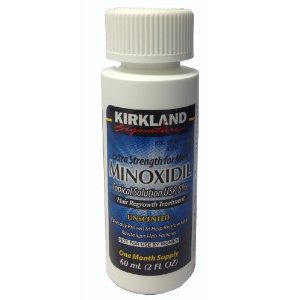
This is the Minoxidil I am using with a dropper, 1 ml twice a day.

This is the Minoxidil I am using with a dropper, 1 ml twice a day.

As mentioned in previous posts my sister arrived to Cuba from Mexico for a short vacation on April the 15th. She brought with her two main things that were not available in Cuba and that I have been using since then: one was the antidepressant (that I already talked about in http://mydearhair.com/2013/05/22/not-depressed-but-in-need-of-antidepressants/), and a bottle of Minoxidil 5%.

I think I mentioned before that when I discovered the first two bald spots I started using the Minoxidil 2% immediately. I had bought it time ago when I started noticing an overall thinning of my once abundant hair. However I never got to be disciplined with the required “two times a day” application. The instructions say that it would take at least 4 months to notice some progress. I don’t think I ever passed from one week of continues used.

Nevertheless I had it here and I started immediately. But also, during those first days of my alopecia areata I read that the Minoxidil 2% (which is the one for women) was not really effective in the treatment of this disease. So I asked my sister to bring the 5% solution with her.

In Mexico, by the way, it is pretty expensive. A small bottle that lasted less than a month was about 40 dollars. Nevertheless I was surprised to see that my medical insurance covered the cost of it.

I also order some from the U.S. and a few weeks after it was brought to me by a “mule” (someone that makes his living bringing things from the U.S. to Cuba) for a small 15 dollar transportation fee. The one I bought in the U.S. (via Ebay) was 16 dollars for a three month treatment (something I can afford for the rest of my life, if needed).

Since then I have religiously used the Minoxidil twice a day (1 ml each time as indicated) and I am starting to see some changes but I am not sure if I should attribute this to the Minoxidil or to any of the many other things I am doing or to all of them.

Anyway I will talk about the changes in a later post.

In the warnings included in the label of this mediation it says that it should not me used if (among other things) one is a woman, has patchy hair loss, and has no family history of hair loss… (check, check, check…).

Nevertheless the dermatologist said that I should continue to use it since it has proven to be effective in the treatment of alopecia areata.

I will report any changes, although I am doing so many things now that I will not know to what to attribute them to.

First visit with dermatologist

marigel 052

The piloactive lotion, the minoxidil and the cortisone cream… all part of my new rutine.

On Tuesday March 19 I met with my new dermatologist, Dr. Silvia Garcia. This was my first appointment with this very nice woman.

“What brings you here?” she asked, “I have Alopecia Areata,” I said. She examined the spots carefully and then she carefully listened to what I had to say and how I discovered this and how daily activities (such as washing my hair) were driving me crazy.

The main thing, she said, “is to forget about it.” This is pretty much impossible since every time I get out of the shower the largest spot is there, watching me from the bathroom mirror.

But what else I have to do? I asked.

She prescribed a series of tests to rule out any infection or thyroid problem, she also told me that every week I have to massage my head with olive oil and in a way that I feel the scalp skin moving from the skull, she also told me to use the Minoxidil (I happened to have the 2% solution, since I bought it a year ago thinking that my hair was thinning and never used it) and she also prescribed a cortisone cream every night applied directly over the bald spots.

She also told me to use something called Piloactive Placenta Lotion which I have to put over my bald spots every other day. I will do some more research about this lotion for a further entry, but apparently it was invented in Cuba and it is only sold in this island.

On top of that, Dr. Garcia will also give me a weekly cryotherapy. She explained this is a therapy with a spray made out of liquid nitrogen, and I will feel a very cold sensation in my head.

All these, she said, is in order to stimulate the follicles which are not dead but just dormant. The hair most likely will grow back, but also most likely it wont be over night. It may take many months she said… and that is the real challenge for me: patience!