This was my hair?!

Jeff and I... about 16 years ago.

Jeff and I… about 16 years ago.

The photo that you see in this entry was taken about 16 years ago. It was at my mother’s 70th birthday party. I like this photo very much because it brings happy memories. When that photo was taken, Jeff (my now husband) and I had been dating for about 4 years and we were very much in love.

I have this photo in the refrigerator because it reminds me of all that good time in our lives. Nevertheless, in the last months that photo is a continuous reminder of something else: I used to have beautiful healthy hair. What in the world happened to it?!

Just one of the locks of hair falling over my shoulder in the photo equals to my whole hair now. It is sad to see what it once was. I guess this happens also with the whole aging process: body, skin and hair never get to be what they used to be in our youth. Up to a point the only solution is resignation, because it is true that it is impossible to stop time. We need to embrace our new selves and get the best out of it.

Nevertheless I still refuse to embrace the current state of my hair. I believe there is much I can do in order to improve it. So, I am doing everything I can in order to achieve something close to what I had one day.

My hair had been terribly damaged and abused even before the alopecia showed up; it had thinned considerably and it was mostly dry and lifeless.

Therefore, I have decided that if I recover my hair I will stop the compulsive drying, styling, dying or sun exposure. I will focus in good healthy food and vitamins. I will keep taking the Biotin (will talk about it later on a different entry), a multivitamin, I will keep using the minoxidil; I will invest in good shampoos, and I will try as much as I can to get my stress under control.

And I swear it is not vanity (or maybe it is)… it is just that I miss my hair!
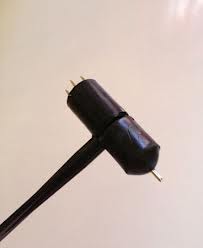


The seven stars mallet

According to the Wood Library Museum of Anesthesiology  the Chinese mallet http://woodlibrarymuseum.org/museum/item/503/moxibustion  (also known as qixingzhen and plum-blossom needle tapping) is a Chinese ancient practice related to acupuncture. The mallet is made out of flexible plastic and it has typically seven needles in the head.

One has to grab the mallet by the handle and repeatedly tap the area of the body where the acupuncture points are. The library goes on to say that “the force and speed with which the tapping is applied varies, based on the purpose and location of the therapy. It may be used for a number of conditions including headache, arthritis pain, dysmenorrhea, stomachache, insomnia, constipation, and certain skin diseases,” including alopecia.

Chinese Mallet

Chinese Mallet

I was kind of surprised by the lack of information on this device on the Internet and I only learned about it because of my nephew, who learned about it through his mom (my wonderful sister in law, Laura).

Laura is the wife of my brother the neurologist, they met in medical school long time ago. And while he pursued a career in neurology, she did it in natural medicine. She has a huge knowledge in homeopathy, acupuncture and other natural alternatives to medicine. She even went to China to study acupuncture.

Well, now I know that when my nephew was diagnosed with alopecia areata and looked for the help of traditional medicine, Laura insisted on trying the mallet. Finally he agreed (he is already an adult… so no easy to tell him what to do) and, according to him, after the first couple of weeks of using the mallet he started to see hair re-grow.

So, I started, everyday for three minutes that I split between the bald spots. The spots ended up covered with blood, but apparently that is how it is supposed to be. Then I cleaned the spots with alcohol and  repeat the following day.

On my last trip to Mexico I met with Laura and she asked me to bring it out the mallet to show me the correct way to do it. She did it harder than I ever did giving me some breaks to recover from the pain. That session with Laura draw a lot of blood… I could see the faces of my brother and sister sitting in front of me quite impressed. She told me that I didn’t have to use it every day, I could take breaks but I have to tap more strongly.

In one of the few websites that talk about this therapy I found a link in  http://www.ehow.com/how_5771914_use-acupuncture-treat-hair-loss.html

I have seen some hair re-grow. But I have to confess that by know I have no idea what has worked and what not of the many things I have done. I will talk more about my incipient (but precious) hair in a following post.

Human placenta… in my head?!

cira garcia 011

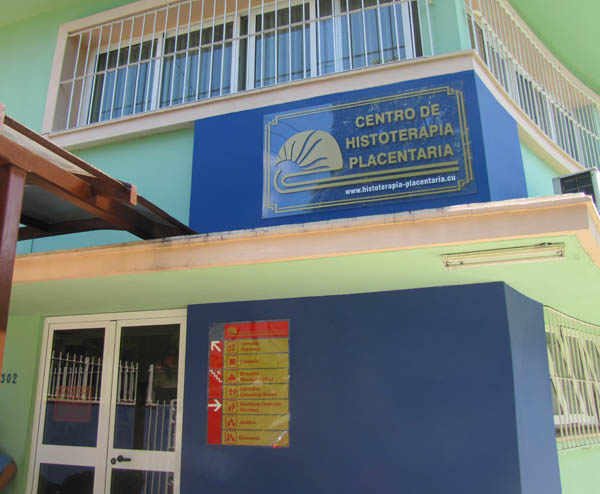
The Placental Histotherapy Center, in Havana, Cuba, where the human placenta shampoo and lotion are sold.

Right after the visit with the dermatologist I headed to the PlacentalHistotherapyCenter which is just two blocks away from the Cira García Clinic (where most foreigners in Cuba get medical treatment.)

At the center they required the prescription issued by Dr. Garcia and they gave me a new prescription from the doctor in site so I could buy the Piloactive Placenta Lotion at the pharmacy in site.

The lotion is sold along with a shampoo for 20 dollars per set (200 ml of each). Both products are made with human placenta and they are the result of research done in the island in the 70s primarily to cure vitiligo, another skin disease which main symptom is the discoloration of the skin.

The research was done by Dr. Carlos Miyares Calo, a physician specialist in Gynecology, Obstetrics and Pharmacology, and professor from MedicalSchool of the University of Havana, Cuba, explains the Center’s website. (http://www.histoterapia-placentaria.cu/)

From the mid 1980s people from many countries were coming to Cuba to look for a cure for the vitiligo and the Center was created.

In the 90s the Cuban scientists created other medications made of human placenta to treat other diseases such as psoriasis, osteoporosis and alopecia.

The lotion and the shampoo are said to stimulate hair growth and regeneration, they increase blood circulation to the scalp and regulate the sebaceous secretions. They are also said to improve the protein synthesis that happens normally inside every hair follicle.

On top of all those things neither the shampoo nor the lotion have secondary effects. I am using them now (it has been a month), so far I have seen no results but as my doctor said it is too early for any results… patience!

First visit with dermatologist

marigel 052

The piloactive lotion, the minoxidil and the cortisone cream… all part of my new rutine.

On Tuesday March 19 I met with my new dermatologist, Dr. Silvia Garcia. This was my first appointment with this very nice woman.

“What brings you here?” she asked, “I have Alopecia Areata,” I said. She examined the spots carefully and then she carefully listened to what I had to say and how I discovered this and how daily activities (such as washing my hair) were driving me crazy.

The main thing, she said, “is to forget about it.” This is pretty much impossible since every time I get out of the shower the largest spot is there, watching me from the bathroom mirror.

But what else I have to do? I asked.

She prescribed a series of tests to rule out any infection or thyroid problem, she also told me that every week I have to massage my head with olive oil and in a way that I feel the scalp skin moving from the skull, she also told me to use the Minoxidil (I happened to have the 2% solution, since I bought it a year ago thinking that my hair was thinning and never used it) and she also prescribed a cortisone cream every night applied directly over the bald spots.

She also told me to use something called Piloactive Placenta Lotion which I have to put over my bald spots every other day. I will do some more research about this lotion for a further entry, but apparently it was invented in Cuba and it is only sold in this island.

On top of that, Dr. Garcia will also give me a weekly cryotherapy. She explained this is a therapy with a spray made out of liquid nitrogen, and I will feel a very cold sensation in my head.

All these, she said, is in order to stimulate the follicles which are not dead but just dormant. The hair most likely will grow back, but also most likely it wont be over night. It may take many months she said… and that is the real challenge for me: patience!

Relaxing at the beach

Sunday March the 10th, the next day after the discovery of the bald
spots I decided to go to the beach. It was a beautiful day and every Sunday a
group of friends go over there. So I figured out that if what I needed was toNothing more ralaxing.
relax there was no better way to do it than sitting by water to contemplate the
waves, enjoy the breeze and talk to my friends.

Sure enough it was really helpful. I first talked to my friend Yolanda and told her about the newly discovered problem. She told me about a friend that has the same thing: alopecia areata. In the case of her friends she has bald spots that come and go constantly depending on her level of stress. It was reassuring to know that those spots “go,” but not so reassuring to know that they may come back.

Then Francesca, another friend at the beach, told me about a friend of hers that also had a bald spot once, a really big one. “What you have is nothing compared to what she had,” Francesca said, and most important “the hair eventually grew back.” I thought at that moment that I would focus all my energy in that: in knowing and believing that my hair will eventually grow back.

And then there was Carlos, another friend that usually goes to the beach on Sundays and who is a psychiatrist (officially MY psychiatrist, now). He told me he has had several patients with the same problem, and that they all eventually recover their hair.

He also told me that he would prepare for me a concoction of Bach Flowers to help me relax. According to Wikipedia, these flower dilutions were developed by a bacteriologist called Edward Bach and are believe to have healing properties, primarily for conditions such as depression, anxiety and stress.

That day, the second day of my life with Alopecia Areata, was good day. I came back from the beach relaxed, optimistic and tanned!